
The Faces of Domestic Violence

Facts and figures about violence against women are overwhelming and maddening, but, it’s the faces that give me the nightmares.  There is a new face added to the gallery of survivors I remember…a women spending the night on her friend’s couch in a new town with her three kids,  trying to sort out what kind of future is possible that will keep them safe from her husband’s rages.  I see the faces of those who ended up in a shelter a friend started, or on the couches of friends or strangers, exhausted, afraid, ashamed, looking for temporary safety for themselves and their children…those who, even though they have won in court lost everything except their futures and their children and had to figure out how to build a new life out of courage and not much else. I cannot imagine how powerless that must feel, or how much courage it takes to seek help.  I see those who have survived.  

And the Mom’s aren’t the only ones who suffer.  Dad’s can be abused too.  Kids may or may not be being hit, but they are shaping their view of themselves, of relationships, and of God based on what they see and hear.  

If you’re reading this, and you’re one of those being abused, please tell someone.  Tell a pastor, a friend, a crisis line…get help. Don’t stop trying til someone listens.   A new life is hard, but it can happen.

http://www.metrokc.gov/dias/ocre/dvresources.htm

http://www.way2hope.org/domestic_violence_facts.htm 

http://www.faithtrustinstitute.org/index.php?p=Domestic_Violence&s=28

Jesus Loves the “Other” Children
 

Jesus loves the little children?

Oh really?  Yes, I see…

He must love the other children

(This don’t look like love to me!)

 In the car, while Mom hits Dad

And I sit in the back

Afraid and sad

As we drive to the church

And park in a row

Where all those nice people

That Jesus loves go…

I think of the words 

Those nice ladies say —

“You can get what you want

From God if you pray,”

So I pray, and I pray

And I pray and I pray…

(But it never makes

The pain go away.)


We smile and look normal

As we walk from the car.

No one knows how bad things are.

No one can tell me

Why I feel so bad-

Like Jesus can’t love me

And neither can Dad.


From the Child:A Child’s Perspective on Child Abuse

(Used by permission)
Facts and Figures on Violence Against Women

Today is the “International Day for the Elimination of Violence against Women.” For a minute, let’s imagine a world where at least one out of three women and girls were not subject to being “beaten, coerced into sex or otherwise abused in their lifetimes, usually by someone they know”.  Violence against women is reported by the UN’s Say No to Violence Against Women” campaign to be “perhaps the most pervasive human rights violation that we know today“.  (The following paragraphs are taken from their report)

Statistics paint a horrifying picture of the social and health consequences of violence against women. For women aged 15 to 44 years, violence is a major cause of death and disability [2]. In a 1994 study based on World Bank data about ten selected risk factors facing women in this age group, rape and domestic violence rated higher than cancer, motor vehicle accidents, war and malaria [3]…. 

Domestic and intimate partner violence includes physical and sexual attacks against women in the home, within the family or within an intimate relationship. Women are more at risk of experiencing violence in intimate relationships than anywhere else.

In no country in the world are women safe from this type of violence. Out of ten counties surveyed in a 2005 study by the World Health Organization (WHO), more than 50 percent of women in Bangladesh, Ethiopia, Peru and Tanzania reported having been subjected to physical or sexual violence by intimate partners, with figures reaching staggering 71 percent in rural Ethiopia. Only in one country (Japan) did less than 20 percent of women report incidents of domestic violence [7]. An earlier WHO study puts the number of women physically abused by their partners or ex-partners at 30 percent in the United Kingdom, and 22 percent in the United States [8].

Based on several surveys from around the world, half of the women who die from homicides are killed by their current or former husbands or partners. Women are killed by people they know and die from gun violence, beatings and burns, among numerous other forms of abuse [10]. A study conducted in São Paulo, Brazil, reported that 13 percent of deaths of women of reproductive age were homicides, of which 60 percent were committed by the victims’ partners [11]. According to a UNIFEM report on violence against women in Afghanistan, out of 1,327 incidents of violence against women collected between January 2003 and June 2005, 36 women had been killed — in 16 cases (44.4 percent) by their intimate partners [12].

According to the Secretary-General’s In-Depth Study on All Forms of Violence against Women, by 2006 89 States had some form of legislative prohibition on domestic violence, including 60 States with specific domestic violence laws, and a growing number of countries had instituted national plans of action to end violence against women…

Limited availability of services, stigma and fear prevent women from seeking assistance and redress. This has been confirmed by a study published by the WHO in 2005: on the basis of data collected from 24,000 women in 10 countries, between 55 percent and 95 percent of women who had been physically abused by their partners had never contacted NGOs, shelters or the police for help [13].”


Arrests in Burma Continue

The US Campaign for Burma blog (see link below) lists the growing number of people in Burma being arrested for simple things like blogging, using a computer, doing a comedy routine, speaking for justice-and facing prison sentences of up to 65 years for it.   http://doiyeh.wordpress.com/  

More hidden from view, is the ongoing military oppression and human rights abuses going on in the ethnic areas of Burma.  (For current documentation and pictures, see the Free Burma Rangers site, and the Karen Human Rights Group site).  

Each Sunday afternoon when we go down to Kent to church with our refugee friends from Burma, I am reminded that this is people’s stories being shown on these sites above.  This is not a news item.  These people I try to converse with in spite of language barriers are people who fled those kind of injustices and are trying to make a new life for their children in a country where they hope for all the same things for their kids we do for ours.   Everyone comes with a story and a history and a dream.  

One of the most powerful moments for me, in visiting a refugee camp the 1st time, was when we were leaving, and an older gentleman shook my hand and said, “Please do not forget us.”  Several years later, we were in another camp, and through an interpreter, we asked the headman what he would like the people to in America to know.  He said that they pray for us, that we will not forget them, and that we will use our freedom to speak for theirs.

God help us never to forget those around the world longing for the same thing.

Waiting for freedom

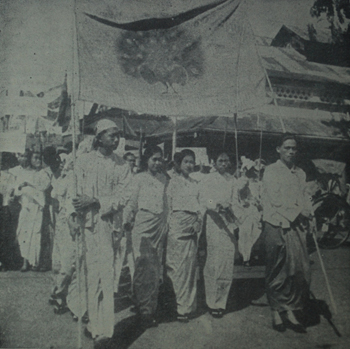
Eighty-eight years after students first led the movement against British rule, the country’s current rulers are busy sentencing student activists to long terms in prison for continuing the struggle for freedom in Burma.”  (see article and picture below from  yesterday’s Irrawaddy)

Students mark National Day in Rangoon 1938
Those who have spoken out, as always in Burma, are still suffering.  Zarganar, a popular comic, was just sentenced to 45 years, and Gambira, a monk involved in the 2007 protests was sentenced to 68 years.  Pastor Eugene Cho included some really good video clips on the situation in Burma and the history of the conflict in his post for today. 
As the picture above from the Irrawaddy demonstrates, Burma has been waiting for freedom and human rights for a long time.  The injustices continue.  US Campaign for Burma has a list of action steps you can do to help speak for and advocate for justice for those suffering under this illegal regime.

What’s love got to do with it?

Not the Tina Turner song, but the title of it, has been replaying over and over again in my head this week along with John 13:34-35 where Jesus commanded us to “…love each other.  Just as I have loved you, you should love each other.  Your love for one another will prove to the world that you are my disciples.”  

Looks like love is supposed to have a lot to do with it!  Not how right, how righteous, how uptight, how socially conscious, how politically correct, how (fill in the blank with your personal favorite) we are…. But how we love each other.  May grace, humility and love guide our dialogue and our interactions, so the world will know who we belong to.

Crisis in Congo-link to a letter to Senators

A google search of “crisis in Congo” returned 2,120,000 hits.  It’s not like the world doesn’t know there’s a problem, a big problem.  Harper McConnell, of Heal Africa, explained that while many international organizations have pulled out of Congo, they are still working in the midst of the conflict.  Their web site tells of the ongoing life changing and life saving work they do.  

Several  ACTION STEPS that we can take are listed on their web site, along with the following explanation: “Through much of the media, the unrest is presented as a tribal conflict, but it is a conflict rooted in control for resources. Resources such as coltan (in latops and cell phones), diamonds, gold, tantalum, minerals which drive the global economy. It is the people of DR Congo who are suffering for the extraction of these minerals which are sold to multinational companies. Write your senator using this letter to tell them to support Senate Bill 3058 and enforce multinationals to follow strict extraction and purchasing guidelines. ”  (There’s also a link to a letter to write to companies using coltan to check their sources, a link to a petition to print out and gather signatures on, and a donation link).  

The video linked here shows another report done by the Pulitzer Center on Coltan and the Congo:  http://www.youtube.com/watch?v=3OWj1ZGn4uM 


“Where are your poor?” (poem)

That was the question our friend Rigo, a Nicaraguan pastor, asked when he visited the US for the first time back in 2000.  Where he pastors, members of several warring drug gangs lay down their weapons outside and call a temporary truce before coming into church.  If they come to faith and leave the gangs, there are no jobs.  They cannot support their families.  Unemployment benefits do not exist.  Churches in North America helped raise money to help him start a woodshop where the guys can learn a marketable skill.  They have plans for other projects as well.  


“Where are your poor?” our honored guest said.

(I was humbled by his words.

His eyes had observed that our country is rich,

Richer even than what he had heard).


In his country many many are poor,

Much poorer than we’ll ever see.

His church gives away what little it has

Just trying to meet their needs.


We give a little while they give a lot

(Seems like the reverse should be true).

Forgive us, Lord, for failing to see

How many times we ignore You.


Give us hearts to see You, Lord,

In the hungry, poor and cold.

Give us hearts to gladly share

Our lives and the things we hold…

To value our brother

More than our comfort.

To know when we give, we receive,

And that we can never

      out-give Your provision—

Lord, help us live

     what we say we believe!


**************************

In Nicaragua, you see the poverty everywhere.  It is not invisible.  Here, it looks like even poor people are rich.  We try to hide our poverty.  But if you look closer, the poor are among us.  God, teach us.